Newborn essentials: what you actually need, and what can wait
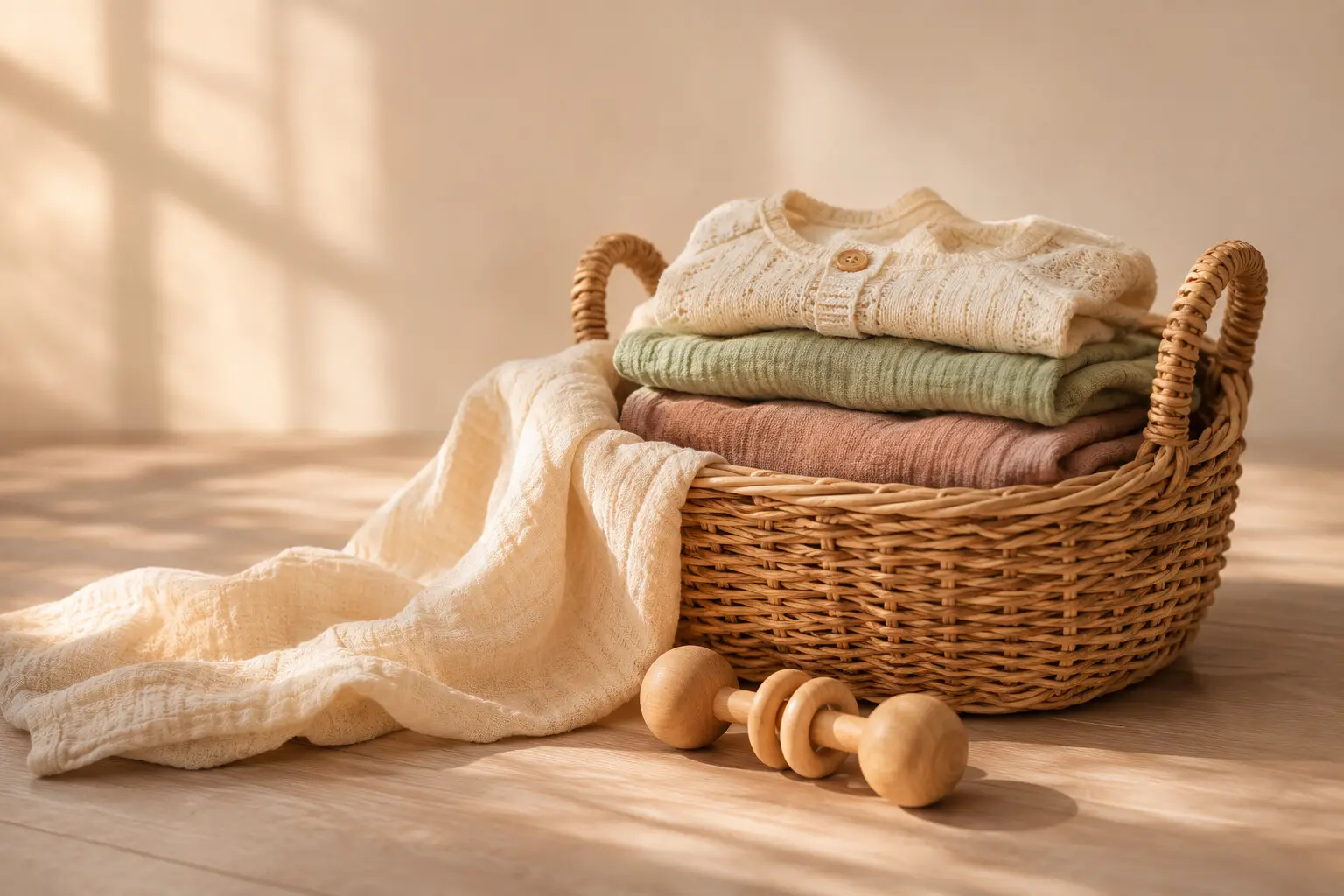
The true essentials for a newborn are a safe sleep space with a firm, flat, well-fitting mattress and 3 to 4 fitted sheets, nappies (up to 10 to 12 changes a day), a small rotation of bodysuits and sleepsuits, what you need for your feeding plan, and a car seat if you travel by car. Almost everything else depends on your home and can wait.
Every shop has a newborn checklist, and every shop’s checklist is long. The useful question is not “what exists?” but “what do we need in the first six weeks, in our home?” Here is a list sorted that way.
Essential for almost everyone
| Item | How many | Why |
|---|---|---|
| Firm, flat, well-fitting mattress | 1 | The NHS advises a firm, flat mattress. A new one is recommended even in a borrowed cot. |
| Fitted sheets | 3–4 | One on, one in the wash, one spare for the 3am change. |
| Long-sleeve bodysuits, 0–3 months | 3–4 | The everyday base layer in cooler weather. |
| Sleepsuits, 0–3 months | 5–7 | Day and night wear for the first weeks. |
| Nappies, first size | 1–2 packs | The NHS says young babies may need 10 to 12 changes a day. Sizes are outgrown fast. |
| Car seat | 1 | Needed for the journey home if you travel by car. |
Depends on your setup
- Cot, bassinet or bedside crib. You need one safe sleep space, not three. A bassinet suits a small bedroom and is usually outgrown by 3 to 6 months.
- Baby sleep bag (2–3). A fitted alternative to loose bedding. Choose the tog for your room: about 2.5 tog at 16–20 °C.
- Newborn-size clothes. A couple of each. Some babies skip the size entirely.
- Sun hat or warm hat. Depends on the season. Babies should not wear hats to sleep indoors.
- Mattress protector, chest of drawers, play mat. Useful, but what you already own may do.
Nice to have, and fine to wait for
Baby monitor, night light, room thermometer, blackout blind, drawer dividers, supply caddy. None of these is needed on day one, and you will know within a fortnight which ones you miss.
The sleep space, specifically
The NHS safe sleep advice shapes what you buy:
- A firm, flat mattress.
- A clear cot: no pillows, duvets, cot bumpers, loose blankets or soft toys.
- Baby in their own cot or Moses basket, in your room, for at least the first 6 months.
So skip the cot bumper set and the cot duvet, however nice they look in the photo.
Why quantities depend on you
Three to four bodysuits works if you wash every few days. Wash weekly and you need more; wash daily and you need fewer. A hot climate changes the clothing list; a fourth-floor flat with no lift changes the pushchair. A fixed list cannot know any of that. Planners such as BabyPlanned ask first, which is why it leads our comparison of baby checklist apps.
Next: the hospital bag checklist.
Questions, answered
How many newborn clothes do I need?
For laundry every few days, BabyPlanned's catalogue suggests 3 to 4 long-sleeve bodysuits and 5 to 7 sleepsuits in 0–3 months, and fewer in newborn size because it is outgrown quickly. Wash more often and you need fewer.
Do I need a new mattress for a second-hand cot?
Health services advise a firm, flat mattress that fits the cot snugly, and a new one is recommended even in a borrowed cot.
What baby items are a waste of money?
It depends on your home. A baby monitor matters in a large house and not in a small flat. That is why a good checklist asks about your home before it tells you what to buy.
When should I start buying baby things?
There is no fixed rule. A practical deadline is 37 weeks, which is when the NHS suggests having your hospital bag packed.
Sources
- BabyPlanned: Newborn checklist (catalogue 2026.10)
- NHS: Reduce the risk of sudden infant death syndrome (SIDS)
- NHS: How to change your baby's nappy
- NHS: Pack your bag for labour
Sources last checked on 11 November 2026.
This guide is educational and does not replace advice from your midwife, health visitor or doctor. If you are worried about yourself or your baby, contact them, or your local emergency number in an emergency.